

Sustainable Materials in Patriotic Clothing Design?
Last Updated: October 28, 2026
Quick Summary
Sustainable materials in patriotic clothing are fibers chosen to reduce environmental impact, such as recycled cotton or recycled polyester, and the label should name the fiber and state the percentage. Check the tag or product page for the exact content before you buy, since the word "eco-friendly" alone tells you little.
- Name the fiber and check its percentage on the tag or product page.
- Recycled content describes what went into the shirt, not how long it will last.
- Ask whether any recycled share has been verified by a named third party.
- Read the print method — direct-to-garment, transfer and embroidery each give a different look and hand.
- Check the care instructions and return policy before you buy.
Table of Contents
- What Sustainable Materials Mean in Patriotic Clothing Design
- Sustainable Clothing Materials You Will See on Labels
- How Recycled Fabric Clothing Is Made and What to Check
- Reading a Label: A Scorecard for Any Patriotic Tee
- Why Print Method Matters as Much as the Blank
- Patriotic Graphic Tees for Men: Designs That Hold Up Beyond the Holiday
- How to Style Graphic Tees for Men Across the Seasons
- Fit, Fabric Weight and Care Habits That Extend a Shirt's Life
- Shopping Your Next Patriotic Tee With the Right Questions
- Frequently Asked Questions
Sustainable materials in patriotic clothing design are a real topic, but the honest answer starts with a limit: the word "sustainable" is not regulated the way a fiber-content label is. One tells you something you can check. The other is a brand's word for itself. Browse the full men's graphic tee lineup to compare designs in one place. This guide from Flag And Family Outfitters walks through the labels, fabrics and checks you can use on any patriotic tee, whether it comes from us or someone else.
What Sustainable Materials Mean in Patriotic Clothing Design
Sustainable materials are fibers and fabrics chosen to reduce environmental impact. That can mean recycled content, organic growing methods or fibers made with fewer inputs. The word "sustainable" gets used loosely, so the first step is to ask what a brand means by it.
A simple rule helps. If a label names the material, you can check it. If it just says "eco-friendly," treat it as marketing until the brand explains what it means.
- Name the fiber: cotton, polyester, or a blend
- Name the content: recycled, organic, or conventional
- Ask for the percentage, not just the word
Sustainable Clothing Materials You Will See on Labels
Most patriotic tees are cotton, polyester, or a blend of the two. Each one brings different tradeoffs in softness, durability and environmental cost. Cotton feels soft and breathes well. Polyester dries fast and holds color, but it is a plastic fiber.
Recycled polyester is made from post-consumer plastic bottles or other recycled material. Recycled cotton is made by breaking down old textiles into new fiber. Both can carry a recycled label, and both should state the percentage on the tag or product page.
To put that into practice on our own listings: the Freedom Runs In The Family T-Shirt and the FAFO Flag T-Shirt both state 100% combed and ring-spun cotton on their product pages. The Timberline Flag T-Shirt's listing covers its graphic and care instructions but does not state a fiber content, which is exactly the gap this guide is about — if a page does not name the fiber, ask before you buy rather than assuming a blend.
Most patriotic tees come down to a few fiber types, and the label tells you which one you have.
| Material | What it is | What to check |
|---|---|---|
| Cotton | Natural fiber, soft and breathable | Name and percentage on the tag |
| Polyester | Synthetic fiber that dries fast and holds color | Whether it is virgin or recycled |
| Recycled polyester | Made from post-consumer plastic bottles or recycled material | Stated recycled percentage |
| Recycled cotton | Made by breaking down old textiles into new fiber | Stated recycled percentage |
| Blend | Mix of cotton and polyester | Ratio of each fiber |
How Recycled Fabric Clothing Is Made and What to Check
Recycled fabric starts with collection and sorting. Old garments or plastic bottles are cleaned and broken down. The material is then spun back into yarn and knit or woven into new fabric. The process still needs energy and water, so "recycled" describes the feedstock, not a free pass.
There are two routes, and the label rarely tells you which one you got:
- Mechanical recycling grinds or shreds material and re-spins the fiber. It is the common route for recycled cotton, and the fiber gets shorter each time, so recycled cotton is frequently blended with virgin cotton to keep the yarn workable.
- Chemical recycling breaks plastic or fiber down to its chemical building blocks and rebuilds it. It is the common route for recycled polyester made from bottles.
That difference matters when you read a tag. A shirt labeled "recycled polyester" is usually drawing on post-consumer plastic. A shirt labeled "recycled cotton" is usually drawing on textile scraps. Neither label tells you the percentage unless the brand prints it.
What to check on the tag or product page
- The exact percentage. "Contains recycled content" is not a number. "40% recycled polyester" is.
- The fiber that was recycled. Recycled polyester and recycled cotton are different supply chains with different trade-offs.
- Whether a third party certified it. Look for a verifiable certification name and a certifying body you can look up, not a house logo the brand drew itself.
- Whether the blend is stated in full. A tee that lists only the recycled share and hides the rest is telling you half the story.
The honest trade-off
Recycled content is a fact about what went into the shirt. It is not a promise about how the shirt will wear, how it will feel, or how long it will last. Judge those separately, using the fiber content and the care instructions. A recycled-blend tee with clear care directions is easier to live with than a conventional tee with none.
The same goes for any claim on our own pages. Read the fiber content where it is stated, and where it is not, treat the gap as a question rather than an answer.
Reading a Label: A Scorecard for Any Patriotic Tee
Use this scorecard on any patriotic tee, from any brand. It works because it asks for facts you can check.
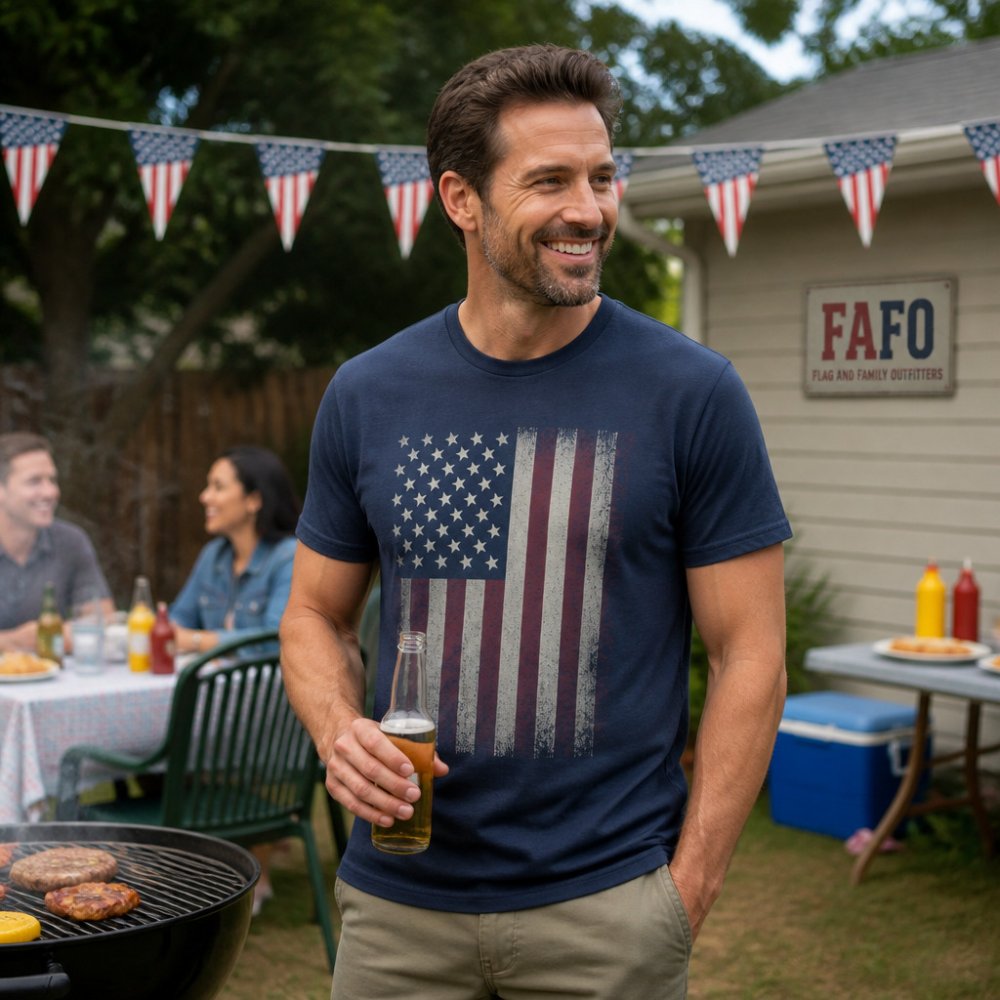
- Fiber content: Is the material named, with percentages?
- Recycled content: Is the recycled share stated?
- Certification: Is there a third-party label you can verify?
- Print method: Is the graphic printed or embroidered, and how is it applied?
- Care instructions: Are wash and dry directions listed clearly?
- Return policy: Can you return the shirt if it does not fit or hold up?
A tee that answers most of these questions is easier to trust. A tee that answers none of them is harder to judge.
Why Print Method Matters as Much as the Blank
The shirt itself is only half the story. The graphic is applied separately, and the method affects how the shirt looks and feels. Direct-to-garment printing puts ink into the fabric surface. Surface transfers lay the design on top, which gives a slightly raised, textured hand. Embroidery stitches the design into the fabric and adds weight where the stitching sits.
Each method has tradeoffs in feel, detail and cost, and none of them is a durability guarantee on its own. Ask which method a brand uses, check how the graphic is described, and flex it between your fingers if you can. FAFO graphics are direct-to-garment printed or embroidered.
Patriotic Graphic Tees for Men: Designs That Hold Up Beyond the Holiday
A patriotic tee should work past the Fourth of July. Bold designs with clean, simple graphics tend to look good with jeans, shorts, or under a jacket. For a bold historic option, see the Gadsden-themed Land Of The Free T-Shirt, which carries a "Land Of The Free — Est. 1776" Gadsden snake chest hit on the front and a larger Gadsden-over-Betsy-Ross graphic on the back.
Where the graphic sits changes how you can wear it. A chest hit stays visible under an open jacket. A large back graphic, like the distressed flag and pine forest on the Timberline Flag T-Shirt, does its work when the tee is worn on its own — it disappears the moment you put something over it.
Pick a design that suits your daily life. A rugged pine-forest flag for camping trips, a clean chest flag for everyday wear, or a bold statement tee for a cookout all have a place in a closet.
How to Style Graphic Tees for Men Across the Seasons
Most layering advice stops at "wear a jacket." Here is the sequence, built from the skin out, so you can assemble the outfit instead of guessing at it.
The three-layer method
- Base layer: the graphic tee. This is the shirt people actually see when the outer layers come off. Pick a design that reads clean at chest height, because a busy graphic fights a busy flannel.
- Mid layer: warmth without bulk. An open flannel, a crew-neck sweater, or a lightweight zip hoodie. The job is insulation, so it should fit close enough to trap warmth but loose enough to go over the tee without bunching at the shoulders.
- Outer layer: weather protection. A denim jacket, a casual jacket, or a heavier coat. This is the layer that takes the wind and the rain, so it can be the loosest of the three.
The rule that keeps this from turning into a pile: each layer gets slightly looser than the one under it. Tight tee, closer mid layer, roomier outer layer. Reverse that order and you get the bulky, sausage-casing look that makes people give up on layering.
Adjust by the day, not the calendar
A fall day is rarely one temperature. Build for the swing:
- Cool morning, mild afternoon. Tee plus an open flannel. Shed the flannel by mid-morning and carry it.
- Mild morning, cold evening. Tee plus a mid layer you keep on, with a packable outer layer for after dark.
- Cold all day. All three layers, with the mid layer tucked or hemmed so it does not hang below the tee.
- Warm and breezy. Tee alone, with a light outer layer tied at the waist or left in the truck.
The practical move is to treat the mid layer as the one you remove first and the outer layer as the one you remove last. For packing ideas, see our guide to rugged patriotic clothing for road trips. That ordering matches how the day actually warms up and cools down.
Keep the silhouette clean
- Check the tee hem against the mid layer. If the tee hangs well below an open flannel, it reads as an accident, not a choice.
- Watch the sleeve stack. Roll or push the mid-layer sleeves rather than letting three cuffs pile up at the wrist.
- Keep the palette tight. A graphic tee already carries color. Let the layers be neutral or pull one color from the design instead of adding a second loud print.
- Size the outer layer for the layers under it. A jacket that fits perfectly over a bare tee will not close over a sweater.
A note on fabric weight
Blend ratio is not fabric weight, and neither one is warmth by itself. A heavier knit blocks more wind; a lighter knit layers more easily. Read the product page for what the shirt actually is, then let the mid and outer layers do the insulation work. That is what they are for.
The Land Of The Free T-Shirt works well as the base of this stack, because its chest hit still reads with a jacket open over it. Save a big back graphic for the days the tee is the whole outfit.
Fit, Fabric Weight and Care Habits That Extend a Shirt's Life
Fit matters more than most people think. A tee that is too tight stretches at the seams. A tee that is too loose can shift and wear unevenly. Choose the size that fits your chest and shoulders, and check the size chart on the product page.
Care habits make a big difference too. Wash cold, use gentle cycles, and turn the shirt inside out to protect the print. Tumble dry on low, or hang to dry. Our care instructions call for a cold machine wash and a low tumble dry, and the care tag is the thing to follow rather than habit.
Shopping Your Next Patriotic Tee With the Right Questions
Before you buy, ask the questions this guide has covered. For more buying context, read our men's patriotic style guide. What is the fiber content? Is any of it recycled, and by how much? How is the graphic applied, and where does it sit? What do the care instructions say? Can I return it?
Answer those questions with the scorecard above, and you will know more about a tee than most shoppers do. Compare a specific flag graphic like the Timberline Flag T-Shirt against that checklist. Browse the full lineup at Flag And Family Outfitters, check each product page for its exact materials, and pick the design that fits your life.

Frequently Asked Questions
What materials are commonly used in sustainable clothing?
The useful question is not whether a fabric carries a green label but what it is made of and how it is printed. A product page that lists the blend and the content of any recycled fiber gives you facts to compare. Be wary of vague words like eco-friendly that name no specific material.
How can you tell what fabric a patriotic shirt is made from?
Start with the care label and the product listing. If neither names a fiber content, ask before you buy rather than assuming a blend. Check whether the graphic is printed direct-to-garment or embroidered as well, since that is a separate question from what the shirt is made of.
What should you look for on a clothing label?
Look for fiber content, care instructions and size, and check that any recycled share is given as a percentage rather than a word.
How can you style a patriotic graphic tee for different occasions?
Keep the graphic as the focal point and let the rest of the outfit stay simple. A crew-neck tee with dark jeans works for a cookout, while a tee under an open flannel or a light jacket suits a cool evening. For a more polished look, pair a clean white or navy tee with chinos and a belt. The simpler the other pieces, the more the flag graphic stands out.
